
Welcome to the Recombinant Antibody Network
The Recombinant Antibody Network is a consortium of highly integrated technology centers at UCSF, the University of Chicago, and the University of Toronto, unified under a common goal to generate therapeutic grade recombinant antibodies at a proteome wide scale for biology and biomedicine.
Given that over half the human proteome is not annotated and that functional antibodies are not reliably available, a complete set of validated antibodies would greatly advance all areas of biology, including cancer therapy and infectious disease control. To undertake these challenges, RAN is systematically and comprehensively profiling families of protein targets using novel, modern high-throughput in vitro technology.
Latest Publications
Ho W W; Chen Y; Slezak T; Zginnyk O; Peters-Clarke T M; Schaefer K; Kossiakoff A A; Leung K K; Wells J A
Comparative analysis of photocatalytic, enzymatic, and chemical approaches to identify canonical and noncanonical surfaceomes Journal Article
In: Proc Natl Acad Sci U S A, vol. 123, no. 43, pp. e2623700123, 2026, ISSN: 1091-6490.
@article{pmid42905542,

title = {Comparative analysis of photocatalytic, enzymatic, and chemical approaches to identify canonical and noncanonical surfaceomes},

author = {William W Ho and Yifei Chen and Tomasz Slezak and Oleksandr Zginnyk and Trenton M Peters-Clarke and Kaitlin Schaefer and Anthony A Kossiakoff and Kevin K Leung and James A Wells},

doi = {10.1073/pnas.2623700123},

issn = {1091-6490},

year  = {2026},

date = {2026-10-01},

urldate = {2026-10-01},

journal = {Proc Natl Acad Sci U S A},

volume = {123},

number = {43},

pages = {e2623700123},

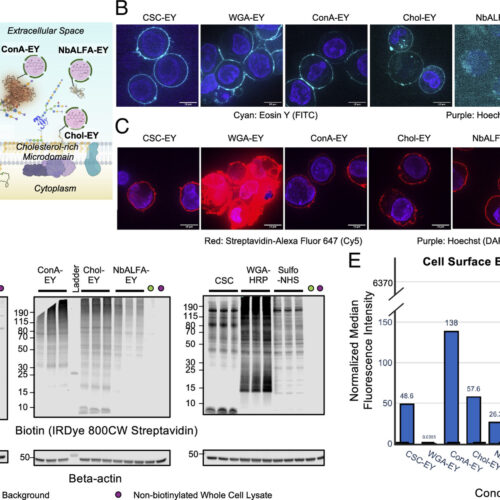
abstract = {The cell surface is a critical nexus in cellular communication and a rich landscape yielding the majority of current therapeutic targets, yet only a small fraction of cell surface proteins have been targeted therapeutically. The cell surface proteome (surfaceome) comprises only ~1% of the human proteome by mass, motivating enrichment strategies to detect surfaceome alterations in disease for drug target discovery. Developments in photocatalytic technology have revolutionized the study of protein neighborhoods around specific targets of interest, but photocatalysis has been underutilized for global surfaceome analysis. Here, we describe five distinct photocatalytic surfaceomics strategies, all without the need for cellular engineering, that apply the photocatalyst Eosin Y attached to different cell surface structures: direct glycan ligation, glycan attachment via two different lectins, membrane insertion, and free in extracellular space. We systematically compare these photocatalytic surfaceomics methods to each other as well as to three established chemical and enzymatic surfaceomics methods. We demonstrate that the different photocatalytic surfaceomics techniques achieve broadly similar canonical cell surface protein enrichment but show some important differences reflective of cell surface attachment mechanism. These mechanistically orthogonal surfaceomics techniques consistently identified numerous nonglycosylated proteins with high concordance, many of which represent an underappreciated class of noncanonical cell surface proteins lacking traditional cell surface protein features that may represent potential drug targets. This study substantially expands options for surfaceomics methods using photocatalytic proximity labeling.},

keywords = {},

pubstate = {published},

tppubtype = {article}

}
Karatza A; Kumru K; Powell J M; Peng C; Hao Y; Ciampricotti M; Nasias D; Hu H; Elnaggar M; Pour M; Chafitz A; Lee Y T; Sahu P; Tan Y J; Xue Y; Ayasun R; Lopez A; Ploszaj M A; Andrussier D; Zhang Y; Sherman F; Loomis C A; Meyn P; So J; Punekar S R; Veluswamy R; Wells J A; Bar-Sagi D; Wong K
ACKR3 Establishes a Squamous-Restricted Immune Checkpoint Axis in Lung Squamous Cell Carcinoma Journal Article
In: Cancer Res, 2026, ISSN: 1538-7445.
@article{pmid42873839,

title = {ACKR3 Establishes a Squamous-Restricted Immune Checkpoint Axis in Lung Squamous Cell Carcinoma},

author = {Angeliki Karatza and Kaan Kumru and Jaylen M Powell and Chengwei Peng and Yuan Hao and Metamia Ciampricotti and Dimitris Nasias and Hai Hu and Muhammad Elnaggar and Maayan Pour and Alison Chafitz and Yeuan Ting Lee and Priyanka Sahu and Yi Jer Tan and Yun Xue and Ruveyda Ayasun and Alfonso Lopez and Magdalena A Ploszaj and Daniel Andrussier and Yun Zhang and Fiona Sherman and Cynthia A Loomis and Peter Meyn and Jonathan So and Salman R Punekar and Rajwanth Veluswamy and James A Wells and Dafna Bar-Sagi and Kwok-Kin Wong},

doi = {10.1158/0008-5472.CAN-25-5347},

issn = {1538-7445},

year  = {2026},

date = {2026-10-01},

urldate = {2026-10-01},

journal = {Cancer Res},

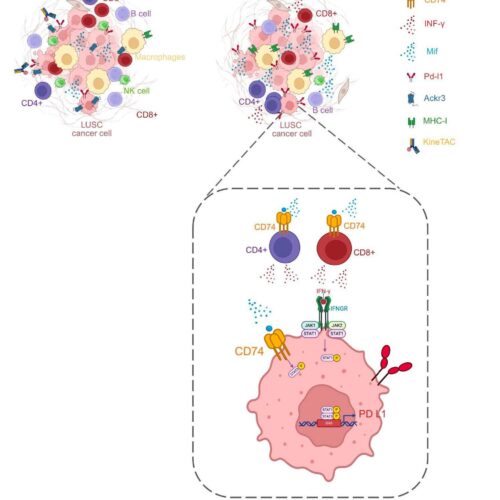
abstract = {Lung squamous cell carcinoma (LUSC) is an aggressive subtype of non-small cell lung cancer with limited targeted therapeutic options and incompletely defined immune-regulatory dependencies. Here, we identified atypical chemokine receptor 3 (ACKR3) as a squamous-enriched regulator that restrains malignant progression in LUSC. Integrative analyses of human LUSC datasets, autochthonous genetically engineered mouse models, and ex vivo organoid systems showed that ACKR3 loss accelerated tumor growth and remodeled the immune microenvironment, marked by reduced CD8⁺ T cell infiltration and increased T cell exhaustion. Mechanistically, ACKR3 limited activation of the MIF-CD74-PD-L1 axis, thereby constraining tumor-cell PD-L1 expression and preserving antitumor immune surveillance. In preclinical LUSC models, treatment with the ACKR3-directed PD-L1 degrader KineTAC, a bispecific molecule that co-engages ACKR3 and PD-L1 to promote lysosomal degradation of PD-L1, enhanced antitumor efficacy, particularly in combination with chemotherapy. Together, these findings define ACKR3 as a squamous-associated immune checkpoint regulator and nominate ACKR3-directed PD-L1 degradation as a tumor-selective therapeutic strategy for LUSC.},

keywords = {},

pubstate = {published},

tppubtype = {article}

}
Mallette E; Blazer L L; Hokanson C A; Chen C; Perez J G; Pavlenco A; Ploder L; Singer A U; Suits M D L; Bhakta S; Junutula J R; Adams J J; Sidhu S S
Strategy for modular assembly of tetravalent, multispecific antibodies Journal Article
In: Protein Sci, vol. 35, no. 10, pp. e70797, 2026, ISSN: 1469-896X.
@article{pmid42757708,

title = {Strategy for modular assembly of tetravalent, multispecific antibodies},

author = {Evan Mallette and Levi L Blazer and Craig A Hokanson and Chao Chen and Julia Garcia Perez and Alevtina Pavlenco and Lynda Ploder and Alexander U Singer and Michael D L Suits and Sunil Bhakta and Jagath R Junutula and Jarrett J Adams and Sachdev S Sidhu},

doi = {10.1002/pro.70797},

issn = {1469-896X},

year  = {2026},

date = {2026-10-01},

urldate = {2026-10-01},

journal = {Protein Sci},

volume = {35},

number = {10},

pages = {e70797},

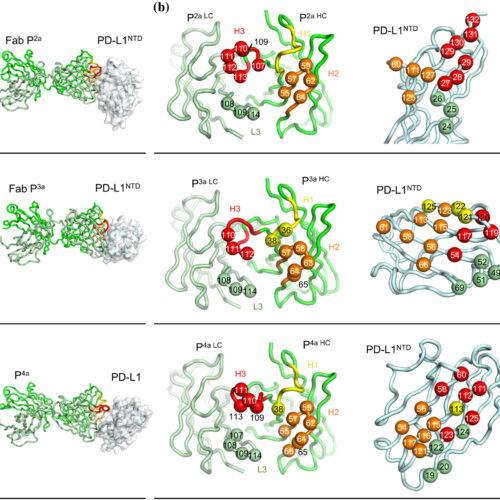
abstract = {Multispecific, multivalent antibodies (Abs) are a burgeoning class of drugs that dramatically expand the pharmacological repertoire beyond traditional therapeutic Abs. Here, we present a simple, modular approach to developing multispecific, multivalent Abs based on a Fab-phage library with a single light chain. Using this library, we created three Abs targeting unique sites on programmed death-ligand 1 (PD-L1) and another antibody targeting CD30. Biophysical and cellular characterization of these Abs demonstrated their functional equivalence to clinically relevant Abs targeting PD-L1 or CD30. We then combined these paratopes into a series of bispecific, tetravalent, triparatopic Abs that retained the functionality of the parental Abs. Structural analysis of each of the Abs in complex with their cognate antigens demonstrated the adaptability of the common light chain to form diverse paratopes with an array of distinct heavy chains.},

keywords = {},

pubstate = {published},

tppubtype = {article}

}
Latest News
Recombinant Antibody Network Partners with Bristol Myers Squibb to Develop Novel Therapies
The Recombinant Antibody Network (RAN), a consortium comprising research groups from UC San Francisco, the…
Absolute Antibody Partners with the Recombinant Antibody Network to Facilitate Access to Engineered Recombinant Antibodies
Absolute Antibody Ltd., an industry-leading provider of recombinant antibody products and services, has announced a…
RAN to collaborate with Celgene on cancer therapeutics development
The RAN has recently signed a 3-year $25M agreement with the Celgene Corporation to develop next-generation,…